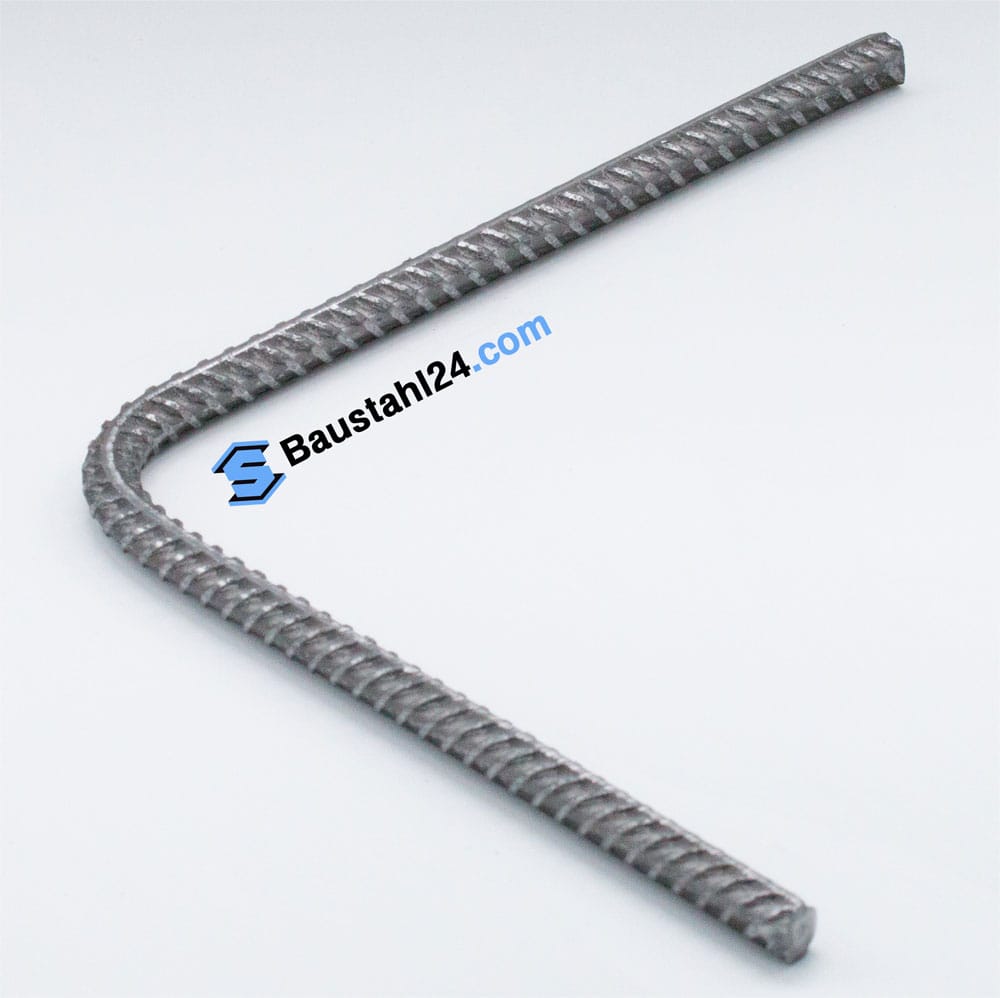
bendsBuy from us in accordance with DIN 488, Eurocode 2 and delivered throughout Germany. Bents are bent rebars made of B500B, whose slanted part absorbs thrust and which are used in the field and support areas of beams. On this page you will find all information about bends: features, applications, processing, standards, quality and ordering.
What are turns?
Bents are bent rebars made of B500B, whose slanted part absorbs thrust and which are used in the field and support areas of beams. As a specialist dealer for reinforcing steel, we deliver bends of consistent quality, documented in accordance with the standards and on time to the construction site. Our site offers an overview of the entire rangeClosed temples.
Characteristics of bends
- Made of rebar B500B
- Defined bending angle (usually 45°)
- Production by bending list
- Minimum bending roller diameter observed
- Exact bending dimensions
| characteristic value | Specification |
|---|---|
| Product | bends |
| Material | Reinforcing steel B500B |
| Standard | DIN 488, Eurocode 2 |
| Delivery | Germany-wide, on request roof |
| Production | Custom made / list |
Applications for bends
Bends are mainly used in reinforced concrete construction for:
- shear reinforcement in beams
- slab beams
- punching areas
- Classic beam reinforcement
The concrete selection and dimensioning results from the static calculation according to Eurocode 2.curved to measureandBending & Cutting.
Bends according to DIN 488 and Eurocode 2
The reinforcement steel used corresponds to the product standard DIN 488, Eurocode 2. The Eurocode 2 (DIN EN 1992-1-1) applies to design and execution – concrete cover, anchorage, overlap and minimum reinforcement. This means that bends are stable, durable and verifiable. Each delivery is made with the required proof.
processing and installation
Bends are positioned according to the reinforcement plan, fixed with binding wire and held in the planned concrete cover via spacers. Shocks and connections are executed over the required overlap lengths. Factory-assembled elements significantly reduce the assembly time on the construction site, since cutting and bending work is no longer necessary.
Quality, test certificate and traceability
We supply bends with work certificate (acceptance test certificate 3.1) and proof of conformity. The reinforcement steel used can be traced via the batch and melt number – this gives you standard-compliant, documented reinforcement that meets the requirements of DIN 488 and Eurocode 2.
economy and prefabrication
Prefabricated bends save time and costs: they are delivered ready for installation, reduce waste and speed up the construction process. Those who plan material, dimensions and delivery dates cleanly reinforce their standards and economically. We would be happy to create a position from your reinforcement list.
Concrete cover and exposure classes
The durability of reinforced concrete depends crucially on the concrete cover. The Eurocode 2 (DIN EN 1992-1-1) sets the minimum concrete coverage, depending on the exposure class (e.g. XC1 for dry interiors, XC4 for alternating wet areas, XD/XS for chloride loaded areas). feast. For bends, spacers at the appropriate height are used to reliably maintain this dimension. Insufficient concrete cover leads to corrosion and cracks; A correctly executed cover ensures the planned useful life. Fittingspacerwe deliver with.
| exposure class | Typical environment | Minimum Concrete Coverage (Guide Value) |
|---|---|---|
| XC1 | Dry interiors | approx. 20 mm |
| XC3 / XC4 | External parts, alternating damp | approx. 25-35 mm |
| xD / XS | de-icing salt, sea water | approx. 40-55 mm |
The exact values result from the exposure class, concrete strength and verification according to Eurocode 2.
anchoring and overlap
To ensure that the tensile forces are safely introduced into the concrete, rods must be sufficiently anchored and pushed. The required anchoring length and joint length of joints depend on the grade of steel, diameter, concrete strength and composite conditions. In the case of bends, these lengths are taken into account in the reinforcement plan – as a fist value, overlap lengths in the ribbed reinforcing steel are in the range of 40 to 60 times the rod diameter, depending on the boundary conditions. The static calculation is always decisive.
Tolerances and quality features according to DIN 488
DIN 488 not only regulates the material parameters, but also dimensional tolerances, rib geometry and marking of the reinforcing steel. Ribbed reinforcing steel is clearly identifiable on its rib pattern; The yield point is 500 N/mm². For bends, this means: defined bending dimensions, consistent quality and a complete allocation to standard and batch. This verifiability is the basis of any statically load-bearing reinforcement.
Quantity determination and calculation
For the calculation of bends, the number of rods, the length of the rod and – for reinforcing steel – the meter weight are used. The weight of a ribbed steel is calculated according to the formula Weight (kg/m) = d² × 0.00617 with D in millimeters. The total weight, which forms the basis for the preparation of the offer, can be determined from the parts list or reinforcement plan. Send us your list – we calculate the position and name a binding fixed price offer.
Alternatives and suitable additions
Depending on the construction task, bends can be combined with other reinforcement products. Proven additions areClosed temples,curved to measureas well asBending & Cutting. Which combination makes economic and static sense depends on the component and the prefabrication depth. We advise you on the appropriate compilation.
Common mistakes – and how to avoid them
- Wrong concrete cover:Without suitable spacers there is a risk of corrosion – match the height to the exposure class.
- Too Short Overlap:Do not estimate shocks according to static specifications.
- Confused positions:Clearly label the components and install them according to the reinforcement plan.
- Missing documentation:The reinforcement can only be tested and approved with a work certificate.
Sustainability of bends
Reinforced steel is almost 100% recyclable and is mainly made from scrap in the electric arc furnace. A needs-based prefabrication of bendings reduces waste and transport. Those who plan quantities and dimensions cleanly not only build in accordance with the standards, but also in a resource-saving manner – an advantage that is increasingly in demand when it comes to proof of sustainability.
Why buy from us?
- Standard bends according to DIN 488, Eurocode 2
- Production according to your reinforcement or list
- Work certificate (3.1) and traceability
- Germany-wide delivery, roof on request
- Binding fixed price offer without hidden costs
Delivery of bends
We deliver bends throughout Germany and on request to Austria, Switzerland and Luxembourg – from the individual position to the complete component reinforcement, position exactly according to your list. A realistic delivery date and the unloading point will be coordinated in advance.
Order bends – step by step
- Provide reinforcement plan or list or dimensions and quantity
- Define product and execution
- Request a non-binding fixed price offer
- Vote for delivery date and unloading point
- Position-accurate delivery to the construction site
You can get your offer on our websiteContact.
Conclusion: Bends
Bends are standard-compliant reinforcement according to DIN 488, Eurocode 2 – bent reinforcement bars made of B500B, whose slanted part absorbs shear forces and which are used in the field and support area of beams. With factory prefabrication, complete documentation and Germany-wide delivery, you will receive sustainable, durable and economic reinforcement. Request your fixed price offer.
Frequently asked questions about bends
What material are bends made of?
Bends are made of rebar B500B and are manufactured according to DIN 488, Eurocode 2.
What are bends used for?
Bends are used, among other things, for shear reinforcement in beams, slab beams, punching areas. The exact selection is given by the statics.
Are bends made to measure?
yes We manufacture bends on a project-related basis according to your reinforcement or list and deliver accurately position.
Do you deliver bends with test certificate?
yes Bends are delivered with work certificate (3.1) and proof of conformity and are traceable.
Where do you deliver bends?
We deliver bends throughout Germany and on request to Austria, Switzerland and Luxembourg.
Weiterführende Quellen: Betonstahl (Wikipedia), Bewehrung im Stahlbetonbau. Buy bends & angles erhalten Sie bei der Bewehrungsstahl Deutschland GmbH normgerecht nach DIN 488 – projektbezogen und bundesweit geliefert.